Luxury, in its truest form, is rarely improvised. It is practiced, refined, and repeated until it becomes instinct.
For Condor Concierge, the division of Condor Security, recognized with the 2025 Luxury Lifestyle Awards for Best Luxury Concierge & Security Services in Canada, that instinct is not left to chance. It is continuously trained at a level that reflects the expectations of the environments they serve: Canada’s most prestigious and private residences.
While the award acknowledged Condor’s ability to merge hospitality and security into a seamless experience, what lies beneath that integration is something less visible, but far more defining: a training philosophy built not only to teach skills, but to shape behaviour. Because in luxury residential environments, it is not enough to know what to do. One must know how to do it, instinctively.
Training as the Architecture of Experience
In many service industries, training is a phase. At Condor, it’s the work.
The company’s approach is layered and ongoing, designed to evolve alongside both risk and expectation. In 2025 alone, Condor delivered hundreds of training sessions to thousands of participants, reinforcing a system where learning is continuous and deeply embedded in daily operations.
This structure is not incidental. It reflects a belief that luxury service is not defined by isolated moments of excellence, but by consistency over time.
“Being luxury takes a lot of investment,” noted Michael Kay of 50 at Wellesley Station Condos, a long-time client and condominium board president. “It’s not something you say you are; it’s how you are perceived. And to maintain that perception, it has to be consistent, every day.”
Consistency, in this context, is not operational. It is human. It is the ability for every team member, across shifts and properties, to deliver the same level of attentiveness, composure, and discretion, whether handling a routine delivery or responding to an emergency.
The Discipline Behind “Effortless” Service
To a resident, luxury often feels effortless. A door is opened at the right moment. A package arrives without being requested. A concern is resolved before it escalates. What remains unseen is the discipline required to make those moments feel natural.
Condor’s training framework is built on repetition—turning protocols into reflex. Fire response procedures, for example, are not simply memorized. They are rehearsed until they become automatic, allowing staff to act with clarity and confidence under pressure.
“It can’t be something you stop and think about,” explains Founder and CEO Benjamin Tabesh. “It has to be something you just know.”
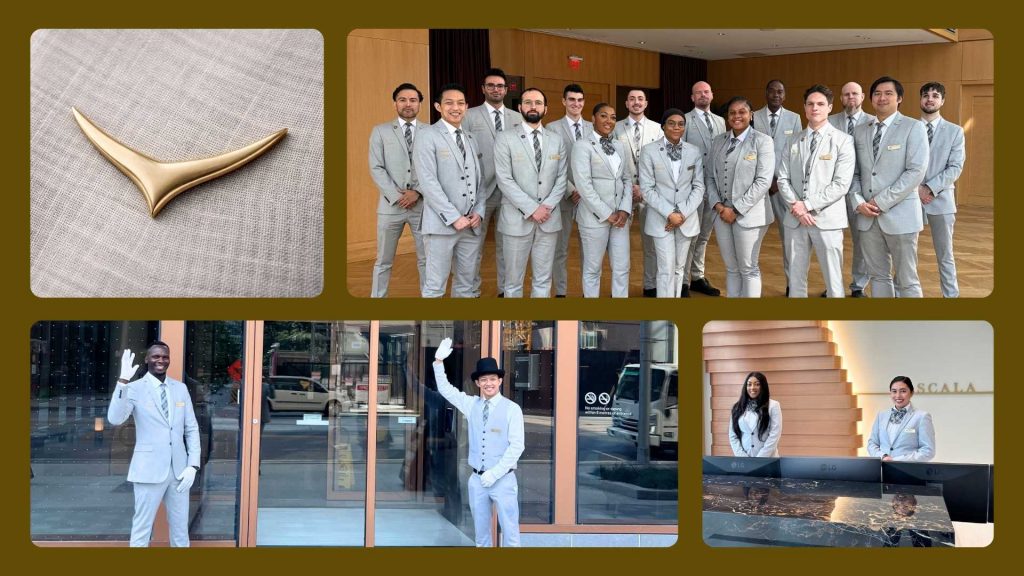
This philosophy extends beyond emergency response. Communication, posture, tone, and situational awareness are all treated as trainable skills. In practice, this creates a dual capability: professionals who can deliver white-glove service while remaining fully prepared to manage complex, high-stakes situations.
Training for What Cannot Be Taught
Technical skills can be standardized. Presence cannot. Yet in luxury environments, presence is often what clients notice first.
The way a concierge stands when a resident enters. The tone used when addressing someone by name. The ability to read a situation, when to engage, when to step back, and when to act. These are not easily codified, but Condor treats them as essential components of its training model.
Part of this development begins with selection. Condor actively recruits individuals who demonstrate independence, emotional intelligence, and a natural inclination toward service. But recruitment is only the starting point. Through coaching, mentorship, and ongoing feedback, those qualities are refined into a consistent standard of performance.
The goal is not to script interactions, but to cultivate judgment so that each resident interaction feels personal and not procedural.
The Role of Trust in a Residential Setting
In a hotel, service is temporary. In a residential building, it is continuous. That distinction changes everything. Residents are not guests passing through. They are individuals building routines, raising families, and entrusting their private spaces to the people who operate at the front line of their community. Over time, that proximity creates a different kind of relationship, one built on familiarity, discretion, and trust. Staff are taught to be personable without overstepping, attentive without being intrusive, and always mindful of privacy.
In practice, this can mean something as simple as adjusting how a resident is greeted, or as significant as being entrusted to check on a vacant suite, manage deliveries in the owner’s absence, or provide reassurance during an unexpected incident. These moments are not part of a checklist. They are the result of training that prioritizes empathy and care alongside execution.
Customization as a Standard
No two properties operate the same way, and Condor’s training reflects that reality.
Before onboarding a new building, the company develops a detailed set of site-specific protocols tailored to the building’s infrastructure, resident demographics, and service expectations.
From there, training becomes adaptive. As feedback is gathered from residents, property managers, and on-site teams, protocols evolve. New behaviours are reinforced. Existing ones are refined. The process is iterative, designed to ensure that service remains aligned with the lifestyle expectations of each community.
“It’s not static,” Tabesh explains.
This adaptability is one of the less visible, but more critical, reasons behind Condor’s long-standing client relationships. In an industry where contracts can shift quickly, sustained partnerships are often the clearest indicator of performance.
The Human Advantage
As technology continues to reshape both security and service, Condor has embraced innovation that enhances efficiency. But it has also remained clear on what cannot be replaced.
A camera may detect movement. It cannot interpret intent.
An automated system may log activity. It cannot offer reassurance.
Technology can support the role, but it cannot replace personal connection.
That belief reinforces Condor’s investment in training, not just as a compliance requirement, but as a strategic advantage. It positions its teams to deliver something increasingly rare: a service experience that feels both highly professional and deeply personal.
As the industry moves further into an era shaped by artificial intelligence and automation, the role of the concierge is not diminishing; it is evolving. In luxury residential environments, where expectations are nuanced and deeply individual, the value of human judgment, emotional intelligence, and presence will only become more pronounced.
At the same time, the luxury residential market continues to expand, bringing with it a growing demand for service that is not only refined but consistent. Meeting that demand requires more than systems or technology. It requires people who are continuously learning, adapting, and refining their craft.
For Condor, maintaining its position at the forefront of this category is not a fixed achievement, but an ongoing commitment. It is one built on continuous training, constant evolution, and the understanding that excellence must be earned, again and again.
Contributors
This article draws on insights from Benjamin Tabesh (Founder & CEO, Condor Security); Michael Kay (VP, Procure by Design), and Board President, 50 at Wellesley Station Condominiums); Serena Baker (Melbourne Property Manager at No. 7 Dale Residences); Joel Train (Residential Experience Manager, Maison 77 Clarendon Boutique Condominiums); and Carlton Peters (Executive Concierge, Shangri-La Residences).